Donnerstag, 19. März 2020

Crystal Crypt Of Zhool


Crystal Crypt Of Zhool is a free mid-level Barrowmoor crypt for use with Barrowmaze or as a small set-piece in your campaign or hexcrawl. Stats are given for use with the DCC RPG, but can be easily adapted to your system of choice.

With illustrations by Johannes Stahl! johannesstahl.com

Download it here: CrystalCryptOfZhool.pdf

Mittwoch, 11. Dezember 2019

Nergal's Followers' Crypt


Nergal's Followers' Crypt is a free, micro-sized low-level Barrowmoor crypt for use with Barrowmaze or as a small set-piece in your campaign or hexcrawl. Stats are given for use with the DCC RPG, but can be easily adapted to your system of choice.

Map by Dyson Logos http://www.dysonlogos.com/

Illustration by Johannes Stahl https://www.instagram.com/goblin.inker/

Download it here: NergalsFollowersCrypt.pdf

Mittwoch, 6. Februar 2019

Prisoners of the Gelatinous Dome DCC Conversion


This is a DCC conversion for Jeff Call's excellent one-page dungeon Prisoners of the Gelatinous Dome! Get it here: gelatinousdome.tumblr.com (direct link to download page)

Illustration by joe made this www.instagram.com/joe_made_this/


You can download a one-page PDF with all the stats here:

These stats are recommended for a party of 4 to 6 first level DCC characters or a mix of level ones and zeroes. 

For 5+ characters, consider adding an additional member to all group encounters (cooks, thieves, gelmen). Roll on the encounter table (2 in 6) for all rooms without enemies or when noisy (use every encounter only once, except gelmen; I didn't care for the vampires, so you have to stat them yourself if you wanna use them). Don't forget to roll for room dissolution if they stay in one place for too long.

Remember also that some of the encounters, like the gregarious ochre jelly or the out-of-luck thieves don't have to result in combat if the players act clever.

OVO, GELMEN OVERLORD
Artwork by joe made this

GREGARIOUS OCHRE JELLY: Init +2; Atk pseudopod +3 (2d6); AC 11; HD 4d10; MV 10’; Act 1d20; SP divides into 1d4+1 2HD jellies when cut or electrocuted (1d6 dmg); SV Fort +2, Ref +0, Will +1; AL N.

DESPERATE COOKS: Init +0; Atk knife +1 melee (1d4); AC 10; HD 1d6; MV 10’; Act 1d20; SP none; SV Fort +0, Ref +0, Will +1; AL N.

INSANE WEREWOLF: Init +5; Atk bite/claw/claw +4 melee (1d8/1d4/1d4); AC 14; HD 3d6; MV 40’; Act 1d20+2d16; SP lycanthropy (infectious if half max hp are lost and Fort vs DC16 fails); SV Fort +4, Ref +4, Will +3; AL L.

SENTIENT BLACK PUDDING: Init +0; Atk pseudopod +7 melee (3d8); AC 13; HD 10d10; MV 20’; Act 1d20; SP can only be harmed by fire, a 2HD (1d8dmg) part splits off when cut; SV Fort +3, Ref +3, Will +3; AL N.

HEIST-GONE-BAD-THIEF: Init +2; Atk longsword +2 melee (1d8+1); AC 11; HD 1d8; MV 30’; Act 1d20; SP thief skills as a lvl 1 neutral thief -1; SV Fort +2, Ref +2, Will +0; AL N.

ANGRY JADE BEAR: Init +3; Atk bite/claw/claw +2 melee (1d6+1); AC 14; HD 4d10; MV 30’; Act 1d20+2d16; SP reverts to jade statue worth 5d6x10 gp, if both claw attacks hit 1d6+1 extra crushing damage; SV Fort +1, Ref +1, Will +1; AL N.

LESSER GELMEN GUARDS: Init +1; Atk touch +3 melee (1d4 plus Fort vs. DC14 or paralyzed); AC 12; HD 1d6; MV 30’; Act 1d20; SP undead-like traits, paralyzation 2d4 rounds, infravision 100’, silent, immune to crits; SV Fort +1, Ref +0, Will +0; AL C.

GREATER GELMEN GUARDS: Init +1; Atk touch +3 melee (1d4 plus Fort vs. DC14 or paralyzed); AC 12; HD 2d6; MV 30’; Act 1d20; SP undead-like traits, paralyzation 2d4 rounds, infravision 100’, silent, immune to crits; SV Fort +2, Ref +0, Will +0; AL C.

OVO, GELMEN OVERLORD: Init +3; Atk magic staff +3 melee (1d10 plus Fort vs. DC15 or permanently lose 1 point of a random physical attribute) or touch +3 melee (1d4 plus Fort vs. DC14 or paralyzed); AC 13; HD 3d10; MV 30’; Act 1d20; SP undead-like traits, paralyzation 2d4 rounds, infravision 100’, silent, immune to crits; SV Fort +3, Ref +1, Will +3; AL C.

Trigonon’s Magic Staff:
Control Trigonon’s Ooze: able to control all ooze in the dome
Paralysis Cloud: 6’ radius cloud of ooze bubbles in a 10’ range, roll d10+10, everybody in the cloud makes Fort save vs. result or gets paralyzed for 2d4 rounds
Convert Matter to Energy: attacking as staff does 1d10 plus Fort vs. DC15 or permanently lose 1 point of a random physical attribute (curable by Restore Vitality)

Wand of Teleportation: 3 charges; for every try, roll INT check (or spellcheck if caster) vs:
Location in view: DC2, minor corruption on crit fail
Familiar location: DC5 or minor corruption, crit fail: major corruption
Known location: DC10 or major corruption, crit fail: greater corruption
Seen once: DC15 or major corruption, crit fail: greater corruption

Lasso of Charm Person:
AGI check to hit, then d20 spellcheck for Charm Person (lasts only as long as they're lassoed)


Freitag, 14. Dezember 2018

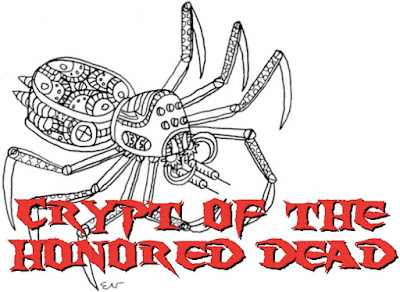
Crypt of the Honored Dead


Crypt of the Honored Dead is a free, low-level Barrowmoor crypt for use with Barrowmaze or as a small set-piece in your campaign or hexcrawl. Stats are given for use with the DCC RPG, but can be easily adapted to your system of choice.

Map by Dyson Logos http://www.dysonlogos.com/

Illustrations by Evlyn Moreau https://www.patreon.com/evlynmoreau

Download it here: Crypt_of_the_Honored_Dead.pdf

Mittwoch, 18. Juli 2018

Random Magical Moon Stone Table

This was inspired by a call for submissions for a moon themed RPG zine by Evlyn Moreau.
Roll a d10 once for each column. Optional: roll a new power and drawback each moon phase. 

d10
Form
Power
Drawback
1
Strange rock. Looks blurry when you focus your vision on it, but normal in peripheral vision. Concentrating on this effect makes any observer dizzy and lose 1 hp.
Moon vision, once per night for 6 turns. In addition to night vision, this makes all magical things glow with a pale aura, so it doubles as detect magic.
Slowly turn into moon child. 1 in 6 chance per use that one of the following changes its color to that of the moon: all nails, all hairs, iris, skin.
2
Tooth (has to replace a regular tooth in your mouth)
Summon ancient wolf spirit. It cannot fight or interact with physical world, but it can scout and possibly give advice. Can move through physical objects (e.g. walls). Stays for one task or up to 1 turn, once each moon phase.
Turn into raging werewolf at next midnight after use. Save negates. Lasts for one turn, afterwards totally exhausted for 6 turns, no natural healing during this night.
3
Orb. Has to be licked to use. Tastes like the void between the stars (with a slight aftertaste of cheese).
Polymorph self into bat for 1 turn, once each moon phase.
If not carefully veiled from direct sunlight, take 1 damage per turn.
4
Ring. Cannot be removed without cutting off the finger.
Bless any weapon to deal magical moonlight damage (extra +1d3 damage). Only works at, and once per night, lasts 1 turn.
Moon aura. In darkness, a faint glow of pale light emanating from your body is clearly visible, making hiding extremely difficult.
5
Ioun stone (orbits your head)
Shoot moonlight beam for 2d6 damage, once per night. Unavailable during new moon.
Vision heavily impaired while in direct sunlight (see everything as if in twilight).
6
Marble. Has to be rolled between your palms or put into mouth to use.
Ability to converse with any creature of the night.
1 in 20 chance that it loses its power after each use.
7
Wand. Using it teleports it exactly one turn into the future. This produces a loud popping sound.
Become an ethereal phantom made from moonlight for 1d12 rounds, unaffected by non-magical weapons. Only works at, and once per night.
Using it drains life energy, take 1d4 damage per use (heals normally).
8
Helmet. It is made out of moon rock and looks damn cool.
Levitate upwards in the direction of the moon. Only works if the moon is visible, and only once per night for up to 1 turn.
Owner has to howl at the moon when going outside at night.
9
Crescent ring/buffalo ring (has to be worn as a piercing jewellery in a suitable spot, like ear or septum)
Polymorph self into wolf for 1 turn, once each moon phase.
Become preferred target in fights against wolves and lycanthropes.
10
Bug (yes, a living moon bug made from moon stone). Likes to sit on your shoulder. Sometimes, it makes a melody by rubbing its wings against each other.
Lesser anti-magic shield. Subtracts one point of damage from all magical damage received, and adds +1 for all saves against magic.
Chill of the void. You are constantly feeling a light chill when not near a fire or in sunlight. You suffer 1d6 additional damage from cold-based attacks.

Freitag, 13. Juli 2018

Barrowmoor Random Encounter Table

This is my Barrowmaze random encounter table for travelling the Barrowmoor. All page numbers refer to the Barrowmaze Complete edition by Greg Gillespie. I advise preparing one or more swamp crypts for encounter #7 by using the Barrow Mound Random Crypt Generator starting on page 245.

Random Encounter Roll:

Roll 1d6 once per 4 hours of travelling (once between Helix and the Barrowmaze):
1-3: roll on Random Encounter table below
4-6: no encounter

Random Encounter Table (d8):

1. Signs: roll on the Barrowmoor Random Encounter Table (p.240), but only encounter signs (d6):
   1-2: that the monsters were there or
   3-4: are nearby (possible encounter depending on party decisions), or
   5-6: find dead monsters
2. Wandering monsters: roll on the Barrowmoor Random Encounter Table (p.240)*
3. Wandering monsters: roll on the Barrowmoor Random Encounter Table (p.240)*
4. Wandering monsters: roll on the Barrowmoor Random Encounter Table (p.240)*
5. Wandering monsters: roll on the Barrowmoor Random Encounter Table (p.240)*
6. Stray Barrowmaze monsters: roll on the Barrow Mounds random encounter table (p.28), with half the number appearing (round up)
7. On strange paths: stumble upon swamp crypt (if travelling with a competent guide, swamp conditions caused a short detour)
8. Lost (ignore if travelling with a competent guide**): add one hour of travel time and check again (random encounter roll d6, if 1-3, roll on this table again with a +1, this is cumulative; if 4-6: back on track)
9. Rolling 9 or higher: found the Barrowmaze, but enter at unusual location, 1d4: 1=N, 2=E, 3=S, 4=W; roll d40 for hex on N/S, or d22 for W/E)

*If part of the journey is happening during the night, roll 1d4 to see at which hour of travel the encounter occurs. If occuring at night, add +1 on the Barrowmoor Random Encounter Table for each hour after dark (or before dawn).

**If one of the characters or a henchman guides the party, let them roll INT DC15. If successful, ignore this encounter (back on track after a 20 minute detour).

Donnerstag, 3. November 2016

Xorn for DCC

A Xorn conversion for the DCC RPG. Guest art by +Ray Otus! Check out his complete inktober art collection at https://plus.google.com/u/0/collection/8RNTkB.


Artwork by Ray Otus

Xorn: Init +0; Atk slam +7 melee (1d3) or bite +7 (6d4); AC 21; HD 7d8+7; MV 30’ or burrow 30’; Act 4d20; SP camouflage, stone meld, immunity to fire and cold, resistance to electricity and edged weapons, all-around vision, smell precious metals 20’; SV Fort +7, Ref +4, Will +5; AL N.

A Xorn can use three slam and one bite attacks per round and fight up to three opponents at the same time. 

It can use camouflage to blend into stone backgrounds, gaining +5 to hide attempts. In combat, it is more likely to meld into any stone surface, then move and attack from somewhere else 1d3 rounds later, thereby gaining surprise (top of initiative order). 

While passing through stone, it can be damaged by a Shatter spell as if it was an inanimate object, and a Transmute Earth spell with a spellcheck result of 20+ on the stone area it passes through will destroy it; a successful lower result will expel it from the stone and turn its body into mud, which prevents it from merging with stone and lowers its AC to 12 for 1d6 rounds while it reforms its structure to stone.

Xorns are immune against any kind of fire and cold and get a Fort save against electrical attacks, negating all damage if successful and taking half damage if failing. They always take only half damage from edged weapons.

Montag, 7. März 2016

The Flayed King DCC Conversion

+Tim Shorts was so nice to send me a print version of his mini-adventure The Flayed King last year, and I recently ran it at a con using Dungeon Crawl Classics. Here are my monster stat conversions, used against a party of five level 1 characters.

You can get the adventure for free here: https://www.rpgnow.com/product/148003/The-Flayed-King?

Draugr

North men skeletons with chainmail, axes and a raging desire to kill the living, I suppose.

DRAUGR: Init +0; Atk axe +1 melee (1d6+3); AC 15; HD 2d12; MV 40’; Act 1d20; SP un-dead traits; SV Fort +0, Ref +0, Will +3; AL C.

Goreth

Huge north man guardian skeleton with tattered chainmail and a shiny blue ring. And a raging desire to kill whoever wants what he’s guarding, I suppose. Wears the Ring of Kearar (see below).

GORETH: Init +2; Atk two-handed sword +3 melee (1d10+3); AC 15; HD 6d12; MV 40’; Act 1d20; SP un-dead traits; SV Fort +2, Ref +2, Will +5; AL C.

Ring of Kearar

Since the original Ring of Raraek that Goreth was wearing was more suited for campaign play, I changed it to something easier to hand out at a convention game:

The Ring of Kearar is sentient, but not aligned. It shimmers with a cold blue light. The wearer can make any melee weapon appear in their hand. It will form in one round; changing it to another weapon is also possible in one round. It appears as if made out of blue light. It gives no bonus to attack or damage, but the damage counts as magical.

Montag, 29. Februar 2016

Twisted and Bloated Ghosts

I created these ghosts for an adventure I ran recently, and if you need some quick ghost stats for your DCC game, they can haunt your players, too. 

The phenomenal guest art is by +Luka Rejec - check out his blog Wizard Thief Fighter!


Twisted Ghost - artwork by Luka Rejec

Twisted Ghosts


Twisted Ghosts: Init +1; Atk lifedrain +2 melee (1d6); AC 15; HD 2d12; MV 30’ fly; Act 1d20; SP un-dead traits, life drain, create spawn, immune to non-magical/non-silver weapons; SV Fort +1, Ref +1, Will +4; AL C.

They are translucent, with their faces, bodies and limbs strangely twisted and bent. They are usually bound to the place where they died.

Un-dead traits: immune to sleep, charm, and paralysis spells, as well as other mental effects and cold damage.

Life drain: all damage done gets added to their hit points (characters can regain lost hp normally).

Create spawn: any living humanoid killed by their life drain rises as a twisted ghost after the next sunset or after 1d4 rounds after “bleeding out” if it is currently night. “Recovering the body” is only possible before sunset and only if the respective ghost has been destroyed.


Bloated Ghosts


Bloated Ghosts: Init +1; Atk lifedrain +3 melee (1d4 + DC14 Fort or 1d4 STA); AC 15; HD 3d12; MV 40’ fly; Act 1d20; SP un-dead traits, life drain, create spawn, immune to non-magical/non-silver weapons, half damage from silver weapons; SV Fort +1, Ref +1, Will +4; AL C.

They are translucent, with their faces, bodies and limbs strangely tumid and bloated. They are usually bound to the place where they died.

Life drain: all damage done (both hp and STA loss) gets added to their hit points (characters can regain lost points normally).

Create spawn and un-dead traits: as above.


Adjusting for character level:


Both of these variants should be a good challenge for a party of 1st level adventurers if the number appearing is about half the number of characters. It will be a very difficult encounter if they don’t have magical or silver weapons (or clerics), so you might drop some hints or rumors so the players have a chance to prepare if they’re clever.

Adjusting for higher level parties: For 2nd level characters, simply add +1 to init, attack, damage, stamina loss, HD and all saves. For 3rd level characters, add an additional +1 on everything.


Silver weapons:


These are not readily available, but if there in a reasonably big city or market, a character may find a weapon suitable for them if they succeed on a luck check. The price should be about 30 times as much as the normal cost of the weapon.

A blacksmith might be willing to coat any weapon with silver for 20 times the normal price of the weapon; this is but temporary: after using such a weapon in a fight against a corporeal enemy, a luck check decides if the silver coating is still functional or wore out. Fighting incorporeal enemies does not tarnish the silver coating!

Magic weapons: These are never for sale. (Well, maybe if they are cursed.)

Mittwoch, 11. März 2015

Soul of the Serpent King


Soul of the Serpent King is a free DCC adventure, written by me and illustrated by +Luka Rejec.

It can be used as a standalone scenario for 6-8 2nd level characters or as an expansion for +Edgar Johnson's Blood for the Serpent King.

Download it here:
Soul_of_the_Serpent_King.pdf

Freitag, 31. Oktober 2014

Absorber Imp


The Absorber Imp with DCC stats and familiar rules. The guest art is by +Noah Stevens - check out his blog The Hapless Henchman!

Artwork by Noah Stevens

An Absorber Imp is a very small demon, typically about one foot tall, with a pitch black hide, a set of leathery wings, often strangely colored eyes and a head like a miniature dragon. They possess child-like intelligence but cannot speak. Their reflexes are quick, they can sense magic and they are able to fly for short periods of time.

Absorber Imps are often used by more powerful demons as retainers, and fulfill simple tasks and services for them. Still, it is possible to encounter an Absorber Imp on its own, if it was lost, trapped, abandoned, or on a mission for or even fleeing from its master. It is very rare to face two or more Absorber Imps in the same place. They don't work well with each other.

Like a lot of imps, they are not truly evil but mischievous in nature and love to play pranks or otherwise annoy their chosen victims. These pranks are never intended to be life-threatening but can sometimes be dangerous. The favorite victims of Absorber Imps are those gifted with magic powers, because they feed on magical energies.

It is not known whether their name originally stemmed from their skin's property of absorbing all light or from their more fantastic ability to absorb pure magic power. These imps can absorb any magical spell or effect in their vicinity, regardless of the intended target, area of effect or power. The original magic effect is cancelled completely and is instead stored inside the imp. The imp can store the magic of up to three spells or other magic effects at the same time for as long as it wishes, potentially forever, but it can also unleash its powers whenever it wants to. Absorber Imps can also decide to devour a magic power that they previously stored. This destroys the magic completely.

When the Absorber Imp releases stored magic, it can choose all variable aspects of its effects, like targets, as if it were the original caster of the spell, or the original user of a magic scroll or wand. If the imp has already currently stored three magical powers, it can choose to absorb a new magic effect and release one of its stored ones as one action.

Absorber Imps are immune to magic weapons and can absorb magical effects of magic weapons hitting them, including all damage, like they can absorb other magic. They can release the stored effects from magic weapons by hitting the intended target with their otherwise not overly dangerous claws.

Due to their abilities to store spells and sense magic, Absorber Imps are rare but highly priced familiars for witches, warlocks and dark mages. Although not easy, they can be befriended, especially if they are well fed with magical energy. An Absorber Imp familiar is a double-edged sword, though, because no matter how well trained, they will never stop playing pranks.

Absorber Imps can be bound into shards of obsidian, if one knows the required ritual. They will stay bound until the word of release is spoken or the obsidian is shattered. Furthermore, magic effects or damage originating from magical obsidian objects or obsidian weapons cannot be absorbed and fully affects the imps. Any damage received from obsidian weapons is a perilous and grave incident for an Absorber Imp and one of the only sure ways to permanently destroy them instead of just sending them back to their shadow realm. For these reasons, most of them are afraid or even repelled by obsidian objects of any kind.

The Absorber Imp's eyes change with the kind of magic powers it has currently stored. An absorbed fireball might turn its eyes into a fiery inferno, a friendship enchantment can make them seem trustworthy and a portal spell might transform their eyes into actual windows into time and space. Often, but not necessarily always, the eyes adjust to the most powerful magic that is currently stored. Pitch black eyes can be a tell for an Absorber Imp with no stored magic whatsoever, or an alarming signal for devastating black magic.

Absorber Imp: Init +3; Atk Claws +1 melee (1d4 + potentially stored magic attack ability); AC 14; HD 2d8; MV 20’, fly 20’; Act 1d20; SP absorb magic, release magic, vulnerable to obsidian (double damage), immune to magic, invulnerable to magic weapons; SV Fort +2, Ref +3, Will +2; AL C.

Absorber Imps as familiars

Optionally, a Judge may allow a player character with the Find Familiar spell to bond with an Absorber Imp if the rolled familiar type is demonic or if an the imp is encountered by a neutral or chaotic spellcaster without a familiar (but the spell must be known). The Absorber Imp will have the abilities and stats described above instead of the usual demonic familiar traits. As a familiar, it can freely absorb spells from its wizard, but can only absorb spells from other casters up to it’s wizard’s caster level per hour (e.g. the familiar of a 5th level wizard could absorb one 3rd level and one 2nd level spell in the same hour). In the case of absorbed magical creature abilities, substitute the creature’s hit dice for spell level. The imp’s immunity to magic and magic weapons remains intact. Absorber Imps’ familiar personality trait is always prankful.

Donnerstag, 10. Juli 2014

Mire Man

In return for illustrating my brain sloth, I wrote up one of +Matthew Adams' wonderful creature designs and gave it some DCC stats, too.

Artwork by Matthew Adams

You might not believe it, but the mire man was once an elf. He still is, in a sense. A failed experiment of the elfin slime lords, a twisted hybrid of an elf and a slime. He has been an outcast for decades, dumped into the swampland surrounding the elfin slime lords' citadel, haunting the swamps and scaring away the few who dare to venture there. The mire man hates everything that has bones. His territory is marked by a countless number of strange sculptures made from the broken bones of creatures that crossed his path, from frogs to unwary travelers. He tolerates nothing but invertebrates. Worms and leeches are his only friends.

The mire man is immune to poison, charm, sleep, paralysis, stun, and polymorph. He ignores extra damage and effects from critical hits that normally damage limbs or bones. Piercing or slashing weapons only do half damage because his slime body just closes the cuts again. His limbs are extremely flexible and bendy, and can be stretched to a length of 10' each, although he usually keeps them from three to five foot long.

As a free action every three rounds, the mire man can try to call upon d20-8 leeches that automatically bite on to his foes that are standing in the mire. These start to drain blood at a rate of 1hp per round and leech. Characters can get rid of leeches by using an action to remove as many leeches from themselves as the result of an Agility check.

If the mire man is reduced to 0 hit points, his slime body explodes vigorously, splashing everybody inside of a 15' radius, requiring a DC 13 Fort save or doing 1d8 acid damage.

MIRE MAN: Init +2; Atk claw +4 melee (1d4 plus Fort DC 12 or paralyzed for 2 rounds) or bite +4 (2d4); AC 11; HD 6d10; MV 30’ in swamp only, otherwise 10'; Act 2d20; SP summon leeches (free d20-8 every 3 rounds), death splash (DC 13 Fort or 1d8 acid), stretching limbs, infravision, heightened senses, immunities: poison, charm, sleep, paralysis, stun, polymorph, critical hits on limbs and bones; SV Fort +2, Ref +2, Will +2; AL C.

Artwork by Matthew Adams

Montag, 7. Juli 2014

Brain Sloths

+Matthew Adams was kind enough to supply a rad illustration for my brain sloths. 
He blogs at Rumble City.

Artwork by Matthew Adams

Brain sloths cling to cave or dungeon ceilings, drop down on hapless adventurers, pierce their skulls and attach to their brains with tentacle-thingies. Then they guide the bodies into their breeding chamber where they are filled with eggs by the enormous brain sloth queen.

BRAIN SLOTH: Init -1; Atk claws +1 melee (2d4); AC 8; HD 1d6+3; MV 10’; Act 1d20; SP climb sheer surfaces, hide on ceilings (DC 1d20+10 Intelligence check or be surprised), piercing drop (+5 attack when dropping on a head from above), brain control (after successful hit to the head, DC 20 Will save or total mind control), immune to mind control and sleep; SV Fort +1, Ref +0, Will +5; AL N.

BRAIN SLOTH QUEEN: Init +1; Atk claws +2 melee (2d6) or stinger +4 (1d8 + insert 1d4 eggs in torso, or in limbs if DC 15 Ref save is made); AC 10; HD 6d8; MV 10’; Act 2d20; SP immune to mind control and sleep; SV Fort +5, Ref +1, Will +5; AL N.

The brain sloth eggs can be removed with a cleric's lay on hands; they are a 3 dice condition.

Alternatively any character can make a DC 10 medical skill check (remember that only characters with appropriate occupations may use a d20, all untrained characters use a d10). A success means the eggs are removed and the patient takes 1d4 damage (only 1 damage on a natural 20). A failure means the eggs are removed, but the patient suffers 1d10 damage (only 1d6 damage if eggs are in a limb). A fumble results in 1d10 damage (1d6 in limb) and all but one egg removed.

After 12 hours inside of a body, the eggs will attach growing tentacles to the nervous system of their host and cause paralyzation. The gestation period is 2d4+8 days, after which the baby brain sloths burst out of the host's body.

Montag, 16. Juni 2014

Yessir

Yessir, the god of following absurd orders, was originally written for the Expanded Petty Gods project by Gorgonmilk. There were a lot more chaotic godlings submitted at that time, so I tried to come up with a cool lawful petty god.


Name: Yessir
Symbol: A full visor helmet with a fist held to the temple
Alignment: Lawful
Movement: 120' (40')
Armor Class: By armor, reduced by 5 (for descending AC)
Hit Points (Hit Dice): 72 hp (16 HD)
Attacks: 1, see below
Damage: By weapon, see below
Save: F20
Morale: 12
Hoard Class: VI
XP: 6,000

Yessir is the god of following absurd orders and a favorite among soldiers of many armies. Out of the ordinary for a lawful god, he is only revered in secret, as openly worshipping him is usually treated as a major offense and punished accordingly. His covert followers are legion in both senses of the word, but they are unorganized. All veneration is clandestine and only shared with true comrades-in-arms.

Privates pray to Yessir every time they are given an order that is, in their opinion, pointless, ineffective or futile. The high art of quick prayer to Yessir consists of uttering his name while in the presence of superiors who have given the order, then mumbling a quiet rebuttal, and following it with touching their temple with their fist as soon as they feel unobserved. The faithful believe that the better the rebuttal and the more pronounced the gesture, the more help Yessir will provide as they fulfill the absurd order. There are untold legends of soldiers on a suicide mission miraculously surviving only through the divine intervention of Yessir.

Yessir appears as a soldier in armor customary to the world where he manifests. His armor is always of the highest quality, well-kept, and donned perfectly. His face remains ever hidden behind a helmet with a full visor. He wears military insignia of the lowest rank.

If Yessir is directly involved in a battle, he never breaks battle formation and always fights on the front line. He wields any weapon that a low-ranking soldier might carry with brutal efficiency. He always rolls an additional damage die and any 1s rolled for damage become the highest possible result for the die instead.

He can command allies and enemies alike within earshot. Yessir’s orders are usually extremely absurd but not lethal on their own. He can give one order per round, but he can never try to command a single target more than once per battle. If the target fails a saving throw against spells, he has to comply with the order.

If a soldier requests help or protection while following an order from a superior, there is a chance that Yessir will assist him. Roll a d20 and apply the soldier’s Wisdom modifier. Additional bonuses may be given at the GM’s discretion, based on how dutifully the soldier has followed orders recently (any disobedience should be punished with negative modifiers), how well the quick prayer was performed, and how absurd the order was. Yessir’s support will vary depending on the roll, but a result of 20 or higher is required to gain his attention. His help can range from minor protection (e.g. a small AC bonus) to a manifestation of Yessir himself. Yessir will never aid a soldier to fulfill a reasonable order or if the soldier does not intend to fully execute the order. Yessir only answers prayers from members of the military or decorated veterans.

Donnerstag, 29. Mai 2014

Dworfen Kaosmobile

+Luka Rejec asked me to "stat up the noble steed" he drew for his Dworfs of Anarchy, so I did (for the DCC RPG):

Dworfen Kaosmobile: Init as driver; Atk hit and run +2+INT modifier of driver (1d6 per 10' distance of acceleration (up to 10d6), every damage die showing a 6 results in a broken bone and losing a point of Strength or Agility); AC 18 (every passenger receives +2 to AC); HD 3d8+14 (any magical fire attack that does at least 8 damage to the Kaosmobile will make it explode, doing 2d6+8 damage to every passenger); MV 100’ (turning takes 1 round); Act n/a; SP breachcruisin'; SV Fort +8, Ref as driver, Will n/a; AL C.


"The Dworfs shall ride once more into the breach. For Kaos and Light." - illustration by Luka Rejec

Check out Luka's blog Cauldrons & Clerics.

Montag, 19. Mai 2014

More Magic Shields

As requested by +Joel Priddy and inspired by +Courtney Campbell's On a Magical Shield, here are some more magic shields.


Magnetus


This iron shield has a protrusion with a coiled wire around it. When activated by pressing a button on the handle, it creates a humming sound. Any attack with a metal weapon that misses to hit by one or two points results in the weapon clinging to the shield, requiring a complete action and successful strength check to free the weapon. Any attack on a fighter that is holding onto a weapon currently clinging to Magnetus receives a +1 to hit.


Ith-Narmant's Shadowshield Glove


When not in use, it looks like a pitch-black glove that does not reflect any light. When activated by clenching one's empty hand, a disk of magic shadow forms instantly at the back of the hand, protecting the wearer like a normal shield.

The shadowshield provides an additional +2 AC against attacks with any fire or light-based weapons as well as a +2 bonus on saving throws versus any fire or light-based magic or effect. The saving throw bonus also applies while the glove is just worn without the shield being active.

This glove is a given as a reward for extraordinary services to priests and champions of Ith-Narmant, the master of shadows, chill and solanaceae. Prolonged use by others might result in the visit of Ith-Narmant's agents.


Displacer Shield


A round shield covered in the dark blue pelt of a magical beast. The wielder of the shield appears to be one foot away from their actual location. In addition to the AC bonus of a normal shield, the displacement effect gives any attacker a -1 on their attack rolls.

Any other action that involves the need to know the location of the shield's wielder, like a cleric's healing touch or chucking a weapon to the displaced fighter, also either requires a successful perception roll at -1 or incurs a -1 on the roll for the action, as applicable.


Double Displacer Shield


As displacer shield, but combining pelts from two magical beasts, displacing the wielder two feet and resulting in -2 on all applicable rolls.


Paineater


Not a shield per se, this symbiotic magical bug can be implanted in the back of one's hand or forearm. In its dormant state, it looks like a big grey wart. When the host loses hit points, the wart quickly grows into a buckler sized shell and sprouts up to 4 chitinous tentacles that actively deflect further attacks.

The AC bonus is equal to the lost hit points, up to a maximum of +4. Each attack that does not hit the host reduces this AC bonus by 1. Further hit point loss increases it again (up to +4). Any healing of hit points also reduces the bonus AC.

The arm hosting a paineater bug cannot be used to wield a weapon or sword. Extracting the bug is only possible by cutting it out of the flesh, resulting in 4 damage.


Donnerstag, 8. Mai 2014

Batbanes

Sometimes called Batbane Women or simply Bat Women, some claim that these chimeras are the offspring of a single woman or group of women that were once human, but struck by a terrible curse for an evil deed they committed. Others suspect that they are the unfortunate results of forbidden experiments with devilish wizardry.

Batbane Women look like a hideous crossbreed of a human female and a bat. Most of their once human features are hidden under monstrous deformities. Leathery batwings stretch from the legs to their elongated arms, with hands and feet ending in long claws. Their mouths are full of sharp teeth and their ears are big and pointy. They are partially covered in a silky black fur, but have patches of bare skin. The hairless spots differ in size and position from one Batbane to the next, with the exposed skin often showing a sickly and pale appearance. Their faces are usually but not always hairless.

The Batbanes are capable of flying for short periods of time, and prefer to attack their prey with dives from above. They can use the claws on their feet to grab and carry away their victims, if those are not much heavier than themselves. Due to their ability to produce and perceive ultrasonic sounds, they can maneuver in absolute darkness and are almost impossible to surprise. Their instincts and behavior are very feral and although they can subsist purely on drinking blood, they tend to also rip apart and eat some of the flesh of their prey in the process of feeding. They get their main sustenance from wild animals, but prefer the more potent humanoid blood when the opportunity presents itself. They eschew the sun, sleep through the day in dark places and only come out to hunt at night.

The curse of the Bat Women is lifted during two nights per year, on the summer and winter solstice. In these nights, their bodies and minds transform back to their human origins, and they are driven to seek the companionship of other human beings. Though still feral in nature, they regain some intelligence and a rudimentary ability to speak. Some Batbanes even grow attached to certain individuals they meet during these nights and try to revisit them again at a later solstice. Usually, their new friends are totally oblivious to the Batbane's true nature. Although a Batbane in human form is generally in a friendly and social mood, they can still get very dangerous if they feel threatened. In very rare cases, when pushed too far, they may even transform back to their inhuman form before the night is over, with dire consequences for anyone nearby.

Some whisper that if a benevolent soul could unravel the original cause for their curse and redeem it, all of them would be saved from their fate, and could live free from the curse or at least die in peace.

DCC RPG stats:

Batbane: Init +2; Atk claws +1 melee (1d4); AC 12; HD 1d8; MV 30’ or fly 30’; Act 1d20; SP pick up opponents after a successful flying attack (avoid with DC 11 Fort save) and drop them from 10' (1d6 damage), never surprised; SV Fort +1, Ref +2, Will +1; AL N.

Dienstag, 29. April 2014

Ith-Narmant's Lantern

This black metal lantern was crafted by the artificer warlocks of Ith-Narmant, the master of shadows, chill, and solanaceae. It has a black leather hood made from humanoid skin, is always cold to the touch and never exudes heat even while burning. It shines an eerie, dim, unnatural bluish light in a radius of 50 feet.

The special oil used in Ith-Narmant's Lantern will burn for up to 4 hours or 24 turns and can only be made with an elaborate ritual, a sacrifice and the blessing of a cleric of Ith-Narmant. If utilizing this oil as a thrown weapon, it will inflict 1d8 cold heat damage on a successful hit and 1d4 cold heat damage on the following two rounds (this can only be prevented with resistance to both magical fire and magical cold).

Animals will never freely enter or stay in the light of Ith-Narmant's Lantern. Characters and monsters of non-chaotic alignment must make a saving throw against magic to enter or stay in the lantern's light. If they fail, they can still enter or stay inside the illuminated area, but will feel very uncomfortable, get -2 on all rolls and try to escape the light after a certain number of rounds (Wisdom score determines the maximum number of rounds for characters, double hit dice does the same for monsters). They cannot try to re-enter the light before one turn has passed.

Ith-Narmant's Lantern can be lit and used by any class. It grants the shadow tunnel ability to everyone in its light. Shadow tunneling allows entering a shadow and emerging from another shadow. Both shadows have to be cast by the blue rays of the lantern, so only shadows from objects or living things that are inside the light radius of the lantern qualify. The destination shadow has to be chosen at the time of entering. If this shadow does not qualify anymore when trying to emerge from it, the traveller is lost in the shadow realm (see table result 6). The complete shadow tunneling takes three rounds: one for entering, one for travelling, and one for emerging.

Shadow tunneling actually means travelling through the shadow realm of Ith-Narmant, and comes not without dangers. Every time when shadow tunneling, make an unmodified d20 roll. On a 1, there are complications (see table).

Shadow Tunneling Complications (1d6):

  1. Receive a demonsign of Ith-Narmant. This can take many forms, but most commonly results in a pitch black mark on the skin that does not reflect any light. These signs are recognized by demon hunters and inquisitors. 
  2. You lose a valuable item in the shadow realm.
  3. A Shadow emerges along with the traveller (see S&W Complete, page 112).
  4. Lose your own shadow for 1d6 days. During this time, you cannot regain lost hp.
  5. You are chilled to the bone and temporarily lose 1d6 Strength. If this brings your Strength to 0, you die and are transformed into a Shadow (see S&W Complete, page 112). Your lost Strength returns after 9 turns. If you die before that happens, you are also transformed into a Shadow.
  6. If you do not yet have a demonsign, you receive one and emerge normally. Otherwise, if you are already marked with a demonsign of Ith-Narmant, you do not emerge from, but are instead lost in the shadow realm of Ith-Narmant. Your friends might try to come and rescue you, if they are brave or foolish enough.


Originally written for the magic item contest over at Tenkar's Tavern, for use with Swords & Wizardry Complete - but of course you can easily use it with any other fantasy RPG. If you're using it with the DCC RPG, I'd suggest to roll on the corruption tables when a character receives a demonsign; and you'll find a Shadow monster on page 425 of the rulebook.

You can find a bit more information about Ith-Narmant in Crawl!#7, along with another of his magic items, the Shadowsword of Ith-Narmant, including DCC RPG stats. 

Freitag, 11. April 2014

Teratic Tome DCC: Onlooker

Dead Cyclops presents a DCC RPG conversion for a monster from +Rafael Chandler's Teratic Tome. If you like this, check out the Kickstarter for Rafael's new bestiary: Lusus Naturae.


The Onlooker belongs to a class of monsters called audiences, so let's talk about those first...


Audiences

Created by the Tenebrous Halflings of the Infinite Crypt, audiences were once among the most dreaded of monsters.

When several of the Tenebrous Halflings neared death, they would perform a necromantic ritual that transferred their souls into a monstrous body that had been stitched together by their chirurgeons. Within this new body, a floating sack of flesh adorned with tentacles, each audience was a collection of diverse personalities.

The audience then continued to stalk the silent corridors of the Infinite Crypt, gathering information, tormenting lesser beings, and assembling troves of forbidden knowledge.

Then Shauva Tiridan, the mad mage, took their eyes.

A wizard of unimaginable power, she hunted down every audience and carved out its eyes to create her legion of ambulators (q.v.).

Now blind and insane, the audiences still glide through dark tunnels, but their mutilator died years ago, so they have no one to vent their rage on save for the occasional adventurer who blunders into their path. Though eyeless, an audience is nonetheless acutely aware of its surroundings, and is not penalized for blindness -- nor is it affected by illusions, or spells such as darkness.

Each audience has the power (and the intellect, and the souls) of several ancient halfling mages, but much of that strength was blunted when the eyes were taken; still, an audience is a formidable foe.


Onlooker: Init +3; Atk tentacled mouth +8 melee (1d8+2) or central maw +8 melee (2d6); AC 18 (tentacles: AC 14); HD 12d8+30 (3hp per tentacle); MV 40’; Act 11d20; SP spellcasting +12, 1/day each: Magic missile, Dispel magic, Scare, Gust of wind, Slow, Force manipulation, Polymorph, Paralysis, Magic shield, Sleep, Spider web; SV Fort +4, Ref +4, Will +8; AL L.


The onlooker appears as a large sphere of greenish-blue tissue, from which dangle 10 tentacles of different lengths. An enormous mouth protrudes from the four-foot-wide central sphere, and each of the tentacles ends in a chattering mouth. The monster sweats a milky substances that reeks of fresh fruit.

Often found near crypts, ossuaries, or graveyards, the onlooker's eleven souls bicker and argue incessantly, debating the necromantic lore that once was their bailiwick. Now, eyeless and stripped of many powers, they float through dust-blanketed necropoleis in search of the interesting-tasting cadavers that sustain them (and occasionally serve as raw material for an experiment of some kind).

If approached, the onlooker will stop chattering long enough to bite with its tentacled mouths (3-10 points of damage) or its central maw (2-12 points); if it feels that the enemy is a dangerous enough to warrant it, the central maw can spit forth magic missiles (6d4+6, 180' range, once per day), and the ten other mouths can utter the following spells (once per day each):
  1. Dispel magic 
  2. Scare 
  3. Gust of wind 
  4. Slow 
  5. Force manipulation 
  6. Polymorph 
  7. Paralysis 
  8. Magic shield
  9. Sleep 
  10. Spider web


More Teratic Tome DCC goodness: 


All material from Teratic Tome used with permission.

Donnerstag, 10. April 2014

Teratic Tome DCC: Scavenger

Dead Cyclops presents a DCC RPG conversion for a monster from +Rafael Chandler's Teratic Tome. If you like this, check out the Kickstarter for Rafael's new bestiary: Lusus Naturae.


Scavenger: Init +1; Atk bone dagger +0 melee (1d3); AC 10; HD 1d8; MV 60' or fly 90’; Act 1d20; SV Fort +1, Ref +1, Will +0; AL N.

Winged humanoids with grey feathers and scabby pink faces, scavengers look like human-vulture hybrids. They reek of the carrion that they feed on.

Most scavengers cultivate symbiotic relationships with powerful predators, which can include carnivorous dinosaurs, giant spiders, or humanoids such as gnolls or bugbears.

Using its piercing caw, and taunting its targets with the few common-tongue obscenities that it knows, the scavenger tries to lure its prey towards the predator, which then attacks. After the other creature has killed the target, the scavenger picks the scraps of meat off the bones.

Though it carries no treasure, the ruqoloi itself is worth a decent amount, as its exoskeleton is valued by many apothecaries (who create various medicines from the material). A damaged corpse can fetch five hundred gold from a wealthy chemist, and an undamaged body can bring ten times that amount.

A scavenger may also attempt to lure a group of adventurers into a dangerous location, such as a trap-heavy dungeon, by dropping coins which it has looted from various corpses -- scavengers have no use for money, but do love shiny things, so these coins will usually be retrieved afterward.

In combat, scavengers use makeshift daggers wrought from bones (1-3) or any weapons they can pilfer. Their treetop nests are stuffed full of useless items (spoiled iron rations, moldy bread, a four-foot length of rope with a bloody frayed end) and a few bits of treasure.


More Teratic Tome DCC goodness: The AcronicalDreg-Stalker, Bothrian

All material from Teratic Tome used with permission.